

Your first few games of American mahjong are supposed to be a little messy. Everyone is still learning, and the table is a lot to track at once. The good news is that the things that stall new players are almost always the same handful of slips, and each one has a simple fix.
Here are the five I see at nearly every table, and exactly how to fix each.

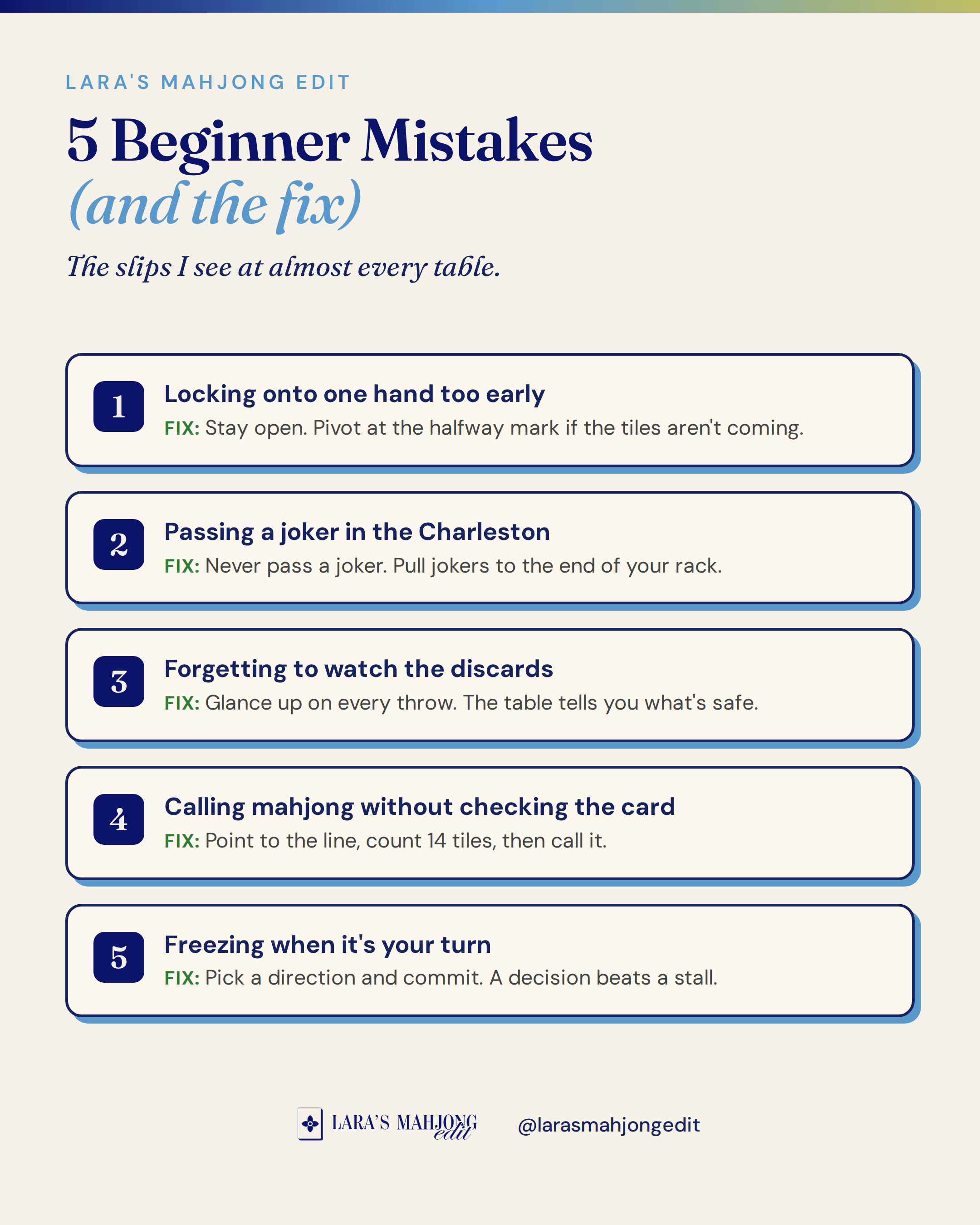
1. Locking onto one hand too early
You picked a hand early, you got attached, and now the tiles you need just are not coming. So you keep waiting for them anyway. That is the most common way a beginner runs out of game.
The fix: check in around the halfway mark. If the tiles you need are not showing up, pivot to a hand your rack already supports. Switching is smart, not quitting.
2. Calling every tile you can
Early on, it is tempting to call a discarded tile every time you are allowed to, just because you can. But every tile you call for an exposure turns those tiles face up for the whole table to see, and it commits you toward one specific hand before you may be ready.
The fix: only call when the tile genuinely moves a hand you feel good about. A tile you can call is not always a tile you should. Staying concealed a little longer keeps your options open and keeps your plan to yourself.
3. Forgetting to watch the discards
Beginners tend to stare at their own rack and tune out everything else. But the discards are where half the game is happening.
The fix: glance up after each throw. The discards show you which tiles are already gone and what the rest of the table is collecting, so you pick more safely and start to read the table sooner.
For little table-side reminders like these, I share quick tips and tile talk over on Instagram. Come say hi at @larasmahjongedit.
4. Calling mahjong without checking the card
It is the most exciting moment and the easiest one to rush. You think you have it, you call it, and then it does not quite match a line on the card.
The fix: before you expose it, point to the exact line on the card and count your 14 tiles against it. An exposed hand that does not match can be declared dead. A dead hand cannot win, and you still pay the winner when someone else does. Ten seconds of checking saves you that.
Do not let this scare you off calling or “pausing” to check. You can say pause or call and check before you lay your hand down, so call when you see it, just confirm before you expose.
5. Freezing when it feels like too much
When the game feels overwhelming, it is tempting to freeze, hold everything, and hope. But indecision quietly wastes turn after turn.
The fix: pick a direction and let your rack and the discards guide each throw. You do not have to play perfectly. Confident and observant beats frozen every time.
The one thing to take with you
If you take one thing from this, take this: play the hand in front of you, not the one you wish you had. Stay flexible, keep an eye on the table, and be kind to yourself while you learn. Every single game teaches you one more read, even the ones you lose.
I still make a version of mistake number one more often than I would like to admit. The difference now is that I catch it at the halfway mark instead of the end. That is all getting better really is, catching the same slip a little sooner each time.

If these little fixes were helpful, here are three easy ways to keep learning with me:
For one calm, beginner-friendly lesson like this each week, subscribe to Lara’s Mahjong Edit right here on Substack. It is free.
For quick daily tips, tile talk, and behind-the-scenes, follow along on Instagram at @larasmahjongedit.
For everything from Lara’s Mahjong Edit, including new lessons, classes, events, and the occasional fun extra, join the Lara’s Mahjong Edit newsletter here.
Lara
This is great insight! Thank you for sharing.