

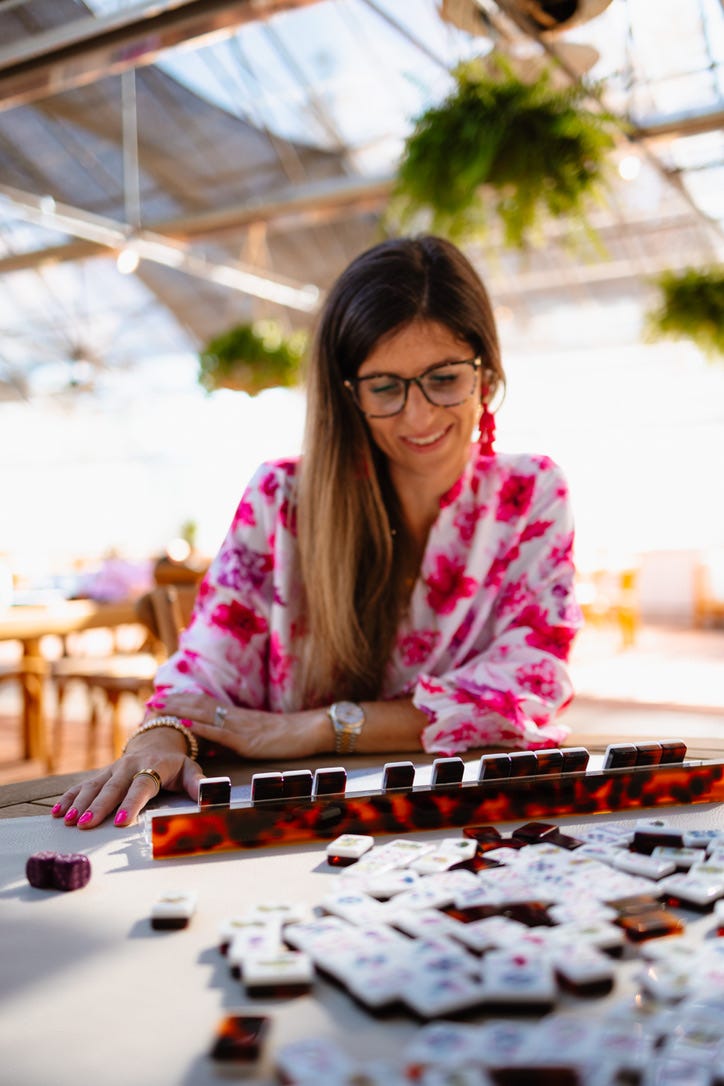
A little over a year ago, I could not play American mahjong. Not one hand. Today I spend my weeks teaching it to women all over the country. People keep asking me how that happened, so here is the honest version.
It started with a text
A friend texted me one day and asked if I wanted to learn mahjong with her. Something we could do together. Neither of us had any idea how to play, and there was no one nearby to teach us. So I did the thing I do with anything I want to understand. I sat down and taught myself, one rule at a time, mostly from ChatGPT (YIKES!). If you have ever tried to learn a real game from an AI that answers every question with total confidence, whether it is right or not, you know the particular comedy I am talking about. I got there eventually.
I expected it to be a fun little hobby for the two of us. I did not expect it to take over my life.
Then forty women showed up
Once it finally clicked for me, I offered to teach a beginner session at our local country club. I figured a handful of friends might come. Over forty women signed up.
That was the moment something shifted. It was not just me who wanted this. A whole room of women wanted a calm, friendly way into a game that looks intimidating from the outside, and almost nobody was offering it that way.
So I built the thing I wished I had
Here is what I kept running into. The information was out there, but it was scattered, and so much of it was written like a rulebook instead of like a friend walking you through your first game. Where I live, there were no local teachers to send anyone to.
So I started making what I wished someone had handed me on day one. Simple guides. Short videos. And eventually a place to actually learn together, week after week, instead of feeling stuck and alone with the card.
I will let you in on the part that surprises people. My background is in finance. I am a CPA, which means I am wired to take something complicated and turn it into a clear, repeatable system. It turns out the NMJL card responds beautifully to that kind of thinking, and most of what I teach is really just that, a calm system you can lean on.
Somewhere along the way I also fell all the way down the rabbit hole. These days I spend more time than I will admit reading everything I can find about this game, and at some point I became a certified instructor almost without noticing.
What I am actually teaching
Somewhere along the way I figured out what this is really about. Most of us do not need more information. We need someone to point at the thing we are already doing well and say, that, do more of that. What was missing was confidence, plain and simple.
So that is what I teach toward, every single week. Not how to memorize the card, but how to sit down at a table and feel like you belong there.
I do all of this alongside a full-time career and two little ones, ages five and seven. So I have a deep respect for your time, and not much patience for fluff. Mostly I try to be the calm voice I wish I had had when I was staring at that card for the first time. I love it more than I expected to.
If that sounds like the kind of teacher you have been looking for, that is exactly what I built the Confidence Club for. It is where I teach this every week, with a whole community of women learning right alongside you. Come see what it feels like to sit down at the table and trust yourself.
Lara
Hi Lara, interesting to read about your journey in Mahjong Edit.
May I offer a few things to consider. I know that American mahjong is quite different to the traditional mahjong I grew up playing - Hakka Rules or Country Rules as it’s known and also Kowloon Rules. I wonder if you have ever looked at the philosophy behind the different rules. Mahjong in America is very much a social game with the organisation behind it making it a game enjoyed by both beginners and experts beause the National Mah Jongg League, being the arbiter of American mahjong rules, publishes a new card of winning hands each year. That annual card is the philosophical key. Players must purchase the new card to know what constitutes a valid win.
Unlike traditional mahjong, the winning hands are not derived from tradition or skill development over generations. An experienced player of thirty years has no inherent advantage over a newcomer if both have memorised this year's card equally well. You know what everyone could be building because the valid hands are public and finite. This shifts the balance toward tile distribution, which is closer to luck than the Chinese variants where the range of possible hands creates genuine information asymmetry. This results in more luck than intution meaning there is less reading of opponents, less inference about what they're building and more focus on the conversation around the table than the tiles on it.
Hakka Rules derives from accumulated tradition, transmitted through practice rather than published annually by any authority. Mastery is real and takes years as I found out - more than 30 in total. The wall cutoff (nine stacks or 18 tiles remain, imposing discipline that no external body decreed is structural, is built into the game's architecture. And the philosophy underneath it, patience, restraint and reading what you have rather than chasing what you want is inseparable from the cultural conditions that produced it.
Kowloon Rules depend on nerve and adaptability , you play against the other players, and you win by reading them better than they read you. The 12 point maximum and one player payout encourages suite or honours building whereas Hakka Rules (which I grew up playing as I am Hakka) with it’s 5 point maximum and chicken hands encourages endurance and restraint as you play against the tiles and against time. With American Mahjong you play against the card, and you win by having memorised the current year's permissible outcomes better than the person across the table. you win by surviving longer than the wall.
I am now finishing my novel: Losing Less: Hakka Rules which is about how and what 4 hands of mahjong reveal about life and reflects what people say and do. The novel is set in multiple countries where the Chinese diaspora expanded but ultimately revolves around Hong Kong land issues and that of my 550 year old clan. Thanks for reading.