

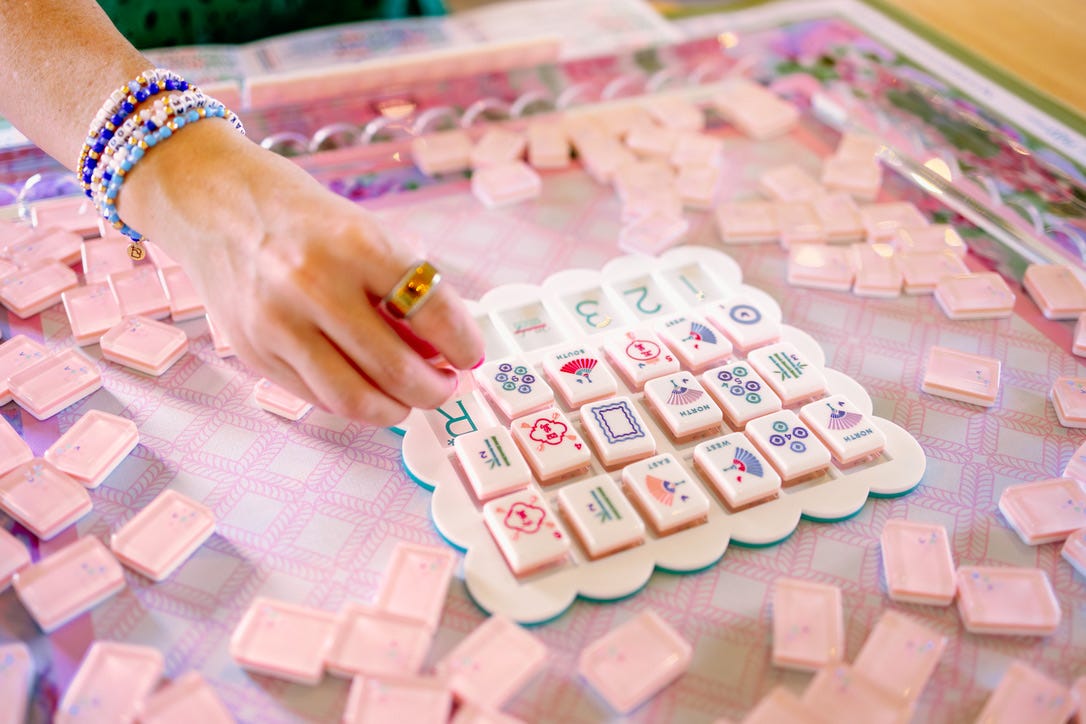
The thing nobody tells you when you are learning mahjong is that you can practice without three other people. You do not need a standing game or a full table to get better. You just need a way to keep your hands and your eyes on the tiles between games, and there are more of those than you think.
For a long time I believed the only way to improve was to play more. Then I started practicing solo at my own kitchen table, and that is when the card finally started to feel like mine. Here are the four tools I actually reach for, in the order I would hand them to a newer player.
Start solo with a practice board
SoloMahj is a physical practice board, not an app. It gives you a single rack so you can deal yourself tiles, run a Charleston, and practice picking a hand off the card, all on your own. It is the lowest-pressure way to get comfortable with the motions: reading the card, recognizing tiles, committing to a direction. I keep one out on the counter and use it in five-minute pockets while the coffee brews. You can shop the boards on my site, and my code LARASMAHJONGEDIT works at checkout.
Add a second rack with two-handed solitaire
Once one rack feels natural, add a second. Two-handed solitaire is a method I built with Jillian, @mahjeltov, and Alicia, @mrsmahj, and it has you running two hands at once, planning each rack's Charleston passes before you peek at the other. That little bit of not-knowing is the whole point. It is the closest you can get to a real Charleston without a real table. I have a free step-by-step guide for it - you can grab it here.
Build all four hands with four-handed solitaire
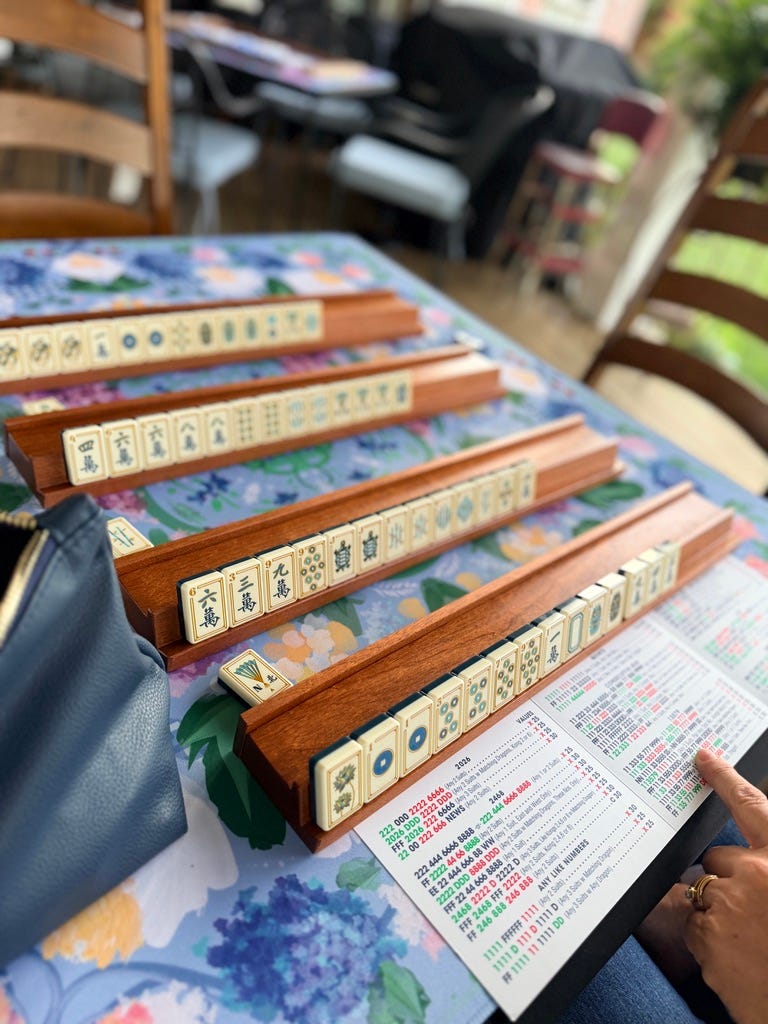
When you are ready for the full board, four-handed solitaire puts all four seats in front of you. This method comes from my friend Alicia, the Mrs. Mahj, and her Practice System is the clearest walkthrough out there, packed with tips and tricks you will not find in any free resource. It is the version I recommend. Because you can see all four hands, it is fantastic for learning the card sections, racking up practice wins, and making real Charleston and pivot decisions.
One honest caveat: since nothing is hidden, four-handed solitaire will not teach you to read your opponents. For that, you need hidden hands and a little pressure. That is the next tool.
Grab Alicia’s Practice System. She also has a free intro guide if you want to try four-handed first.
Play live online when you want real opponents
When you want hidden hands and a real game, I Love Mahj is where I send everyone. It is a website where you can play against real people or the computer, practice reading exposures, and drill specific skills in its exercise room. This is where you learn the one thing four-handed solitaire cannot teach you: what your opponents are actually building, and how to play around it. You can try it with my code LARASMAHJONGEDIT.
Which one should you start with?
Wherever you are right now. If the card still looks like a foreign language, start with one rack. If your Charleston instincts are shaky, go two-handed. If you want reps and wins, four-handed. If you want to feel a real game, go online. The point is never which tool. The point is that you keep tiles in front of you between games, even for a few minutes, because that is what actually moves you forward.
I send free guides, practice prompts, and the occasional pep talk to my email list every week. If you want the step-by-step for two-handed solitaire and the rest, that is the place to get it.
Lara