

If you have ever picked up the National Mah Jongg League card and felt your eyes glaze over, you are in very good company. It looks like a grid of numbers and letters in three colors, with little parentheses tucked in, and no obvious place to start. Most people assume they are missing some secret key.
You are not. The card is not a rulebook you have to memorize. It is this year’s menu of winning hands, and once you know how it is organized, it reads less like code and more like a recipe card.
Let me walk you through it the way I wish someone had walked me through it.
The card is a list of winning hands, in 9 sections
The whole card is one thing: this year’s list of the hands you are allowed to win with. That list is split into 9 sections, and each section is named for the type of tiles it uses.
Here are the sections on the 2026 card:
2026
2468
Any Like Numbers
Quints
Consecutive Run
13579
Winds and Dragons
369
Singles and Pairs
You build one hand from one line in one section. That is it. The 2468 section uses even numbers. The 369 section uses 3s, 6s, and 9s. Winds and Dragons use those tiles. You do not have to understand all 9 sections at once. You just have to find one line you like and build it.
The colors tell you how many suits, not which ones
This is the single thing that trips up almost every beginner, so read this part twice.
First, the basics: mahjong tiles come in three suits, called dots, bams, and craks. On the card, the color of the numbers does not mean a specific suit. It tells you two things: how many suits a hand uses, and how those suits are distributed across the line. It never tells you which suits to use. That part is your choice.
Same color means same suit. Different colors mean different suits.
333 666 6666 9999 or 333 666 6666 9999 (Any 2 or 3 Suits) 25 X
So if a line is all one color, you build the whole thing in a single suit. If it shows two colors, you use two different suits, and the colors show you which groups belong together. You pick the actual suits. The card only tells you how many, and how they are split.
The first line of the 369 section shows this perfectly, because it gives you two versions:
333 666 6666 9999 uses two colors, so two suits. The groupings of three 3s and 6s share one suit, and the groupings of four 6s and the 9s are a different suit.
333 666 6666 9999 uses three colors, so three suits. The 3s and 6s are one suit, the second set of 6s is a second suit, and the 9s are a third suit.
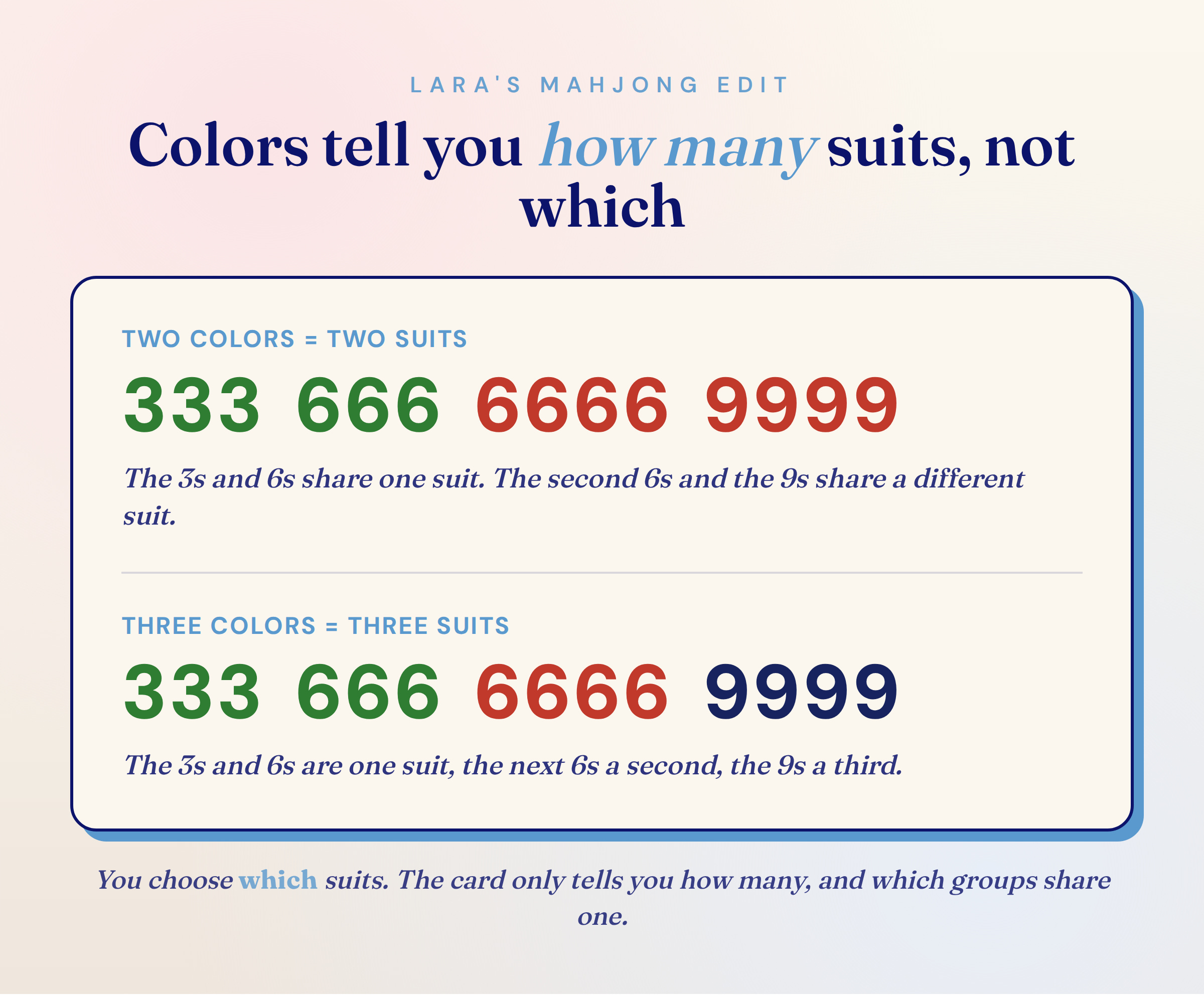
Same numbers, different coloring, different number of suits. The card is not telling you to use bams or dots. It is telling you how many suits to use and which groups share one. You choose which suits those are. That is also why the card notes “Any 2 or 3 Suits” beside this line.
Once that clicks, half the mystery of the card disappears.
Every line is built from groupings
Each line is made of small groups of tiles. These are the building blocks, and they have names based on how many tiles are in them.
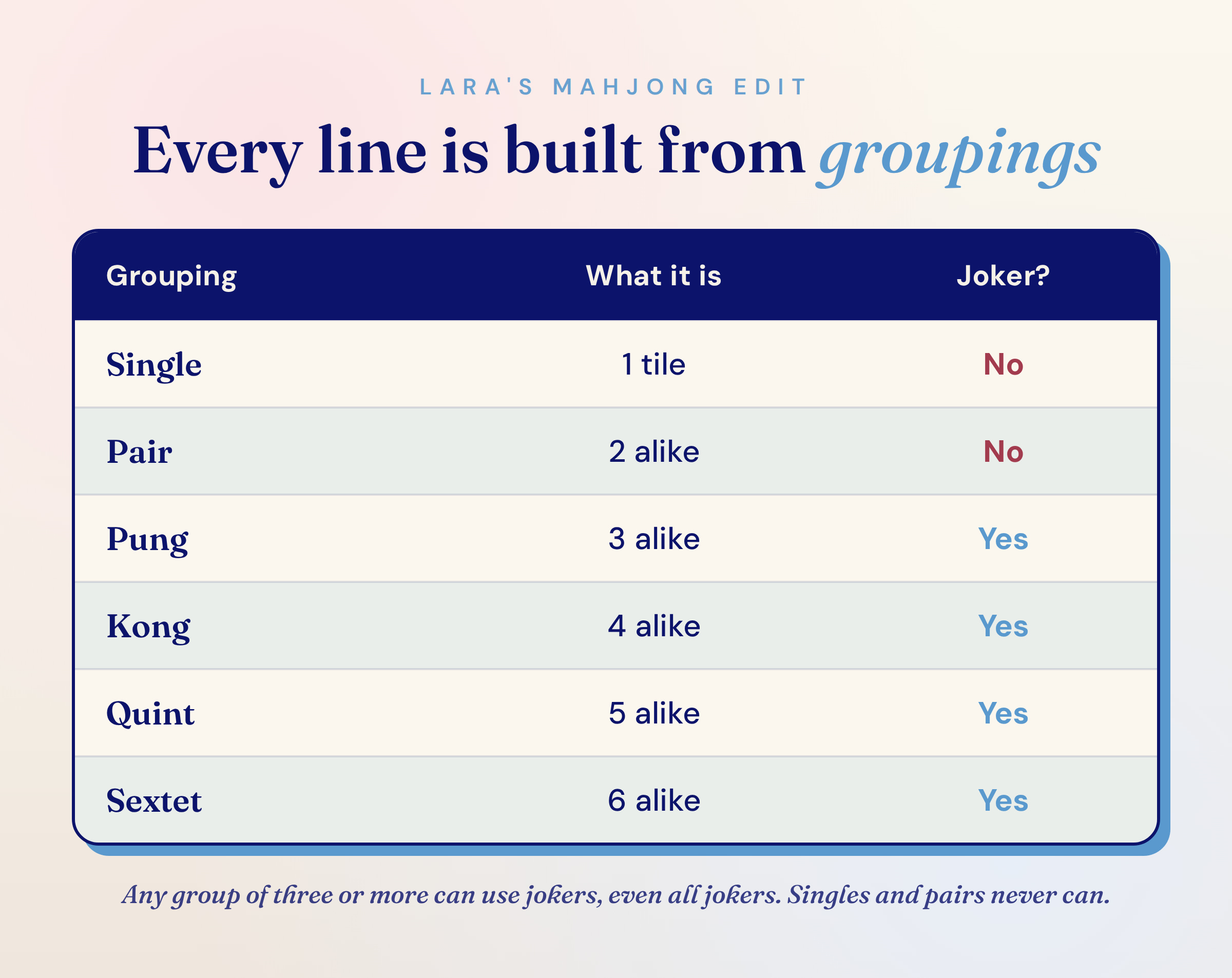
A quick joker note, because it matters: singles and pairs never use a joker. Pungs and kongs can. Quints and sextets always need a joker, because only four of each tile exist in the set.
So a line in the 2468 section might be a pung of 2s, a pung of 4s, a kong of 6s, and a kong of 8s. In one color, you build all of it in a single suit. In two colors, you split it across two suits.
Not every group is matching tiles
Here is a small twist that confuses people. Some groups are not matching tiles at all. They are different tiles sitting in a row, and each one is a single. Because they are singles, they never use a joker.
Two examples you will see:
Four Winds: N, E, W, S. Four individual, different tiles.
A run of numbers like 2, 4, 6, 8. Four individual, different tiles.
A year hand like 2, 0, 2, 6 works the same way. Four different tiles, all singles, no jokers. So when you see those, you know not to go looking for a joker to help you.
Now read one full line, left to right
Once you know the pieces, reading an actual line is simple. Every line reads the same way, left to right: the tiles first, then the parentheses, then the points.
Say the card shows this:
222 444 6666 8888 or 222 444 6666 8888 (Any 1 or 2 Suits) 25 X
Read left to right, it says: a pung of 2s, a pung of 4s, a kong of 6s, and a kong of 8s.
The tiles and their groups are the pattern. That part is fixed. You collect exactly those tiles in exactly those groups. You cannot mix in a tile the line does not call for.
The parentheses are the only flexibility. They are your allowed swaps, like a recipe that says “any 1 or 2 suits” or “these numbers only.” That is the one thing you get to choose. Read it before you commit.
The points are what the hand pays when you win it. The X or C tells you exposed or concealed. X means you can expose tiles as you build. C means you keep the hand concealed and draw it yourself until the tile you win on.
That is the whole card. Pick a line, follow the recipe, and use only the swaps it allows.
The trick that finally made it stick for me
I read about the card for ages before any of it felt real. What changed everything was laying it out with actual tiles.
Pick one line you like. I would start in 2468 or 13579, the two friendliest sections. Read it out loud, left to right: the tiles, then the parentheses, then the points. Then build that one line on your rack with real tiles in front of you.
The moment you do that, the card stops being abstract. You are not decoding a grid anymore. You are looking at a hand you could actually make. Do that with one line tonight, and you will read the card a little differently tomorrow.
You do not need to learn all 9 sections this week. You need one line, read the right way. The rest follows.
Two easy ways to stay in the loop:
For these card-reading lessons and strategy notes, subscribe to Lara’s Mahjong Edit right here on Substack. It is free.
For everything from Lara’s Mahjong Edit, including new lessons, classes, events, and the occasional fun extra, join the Lara’s Mahjong Edit newsletter here.
You made sense of the Blind Pass timing for me! Thank you.