

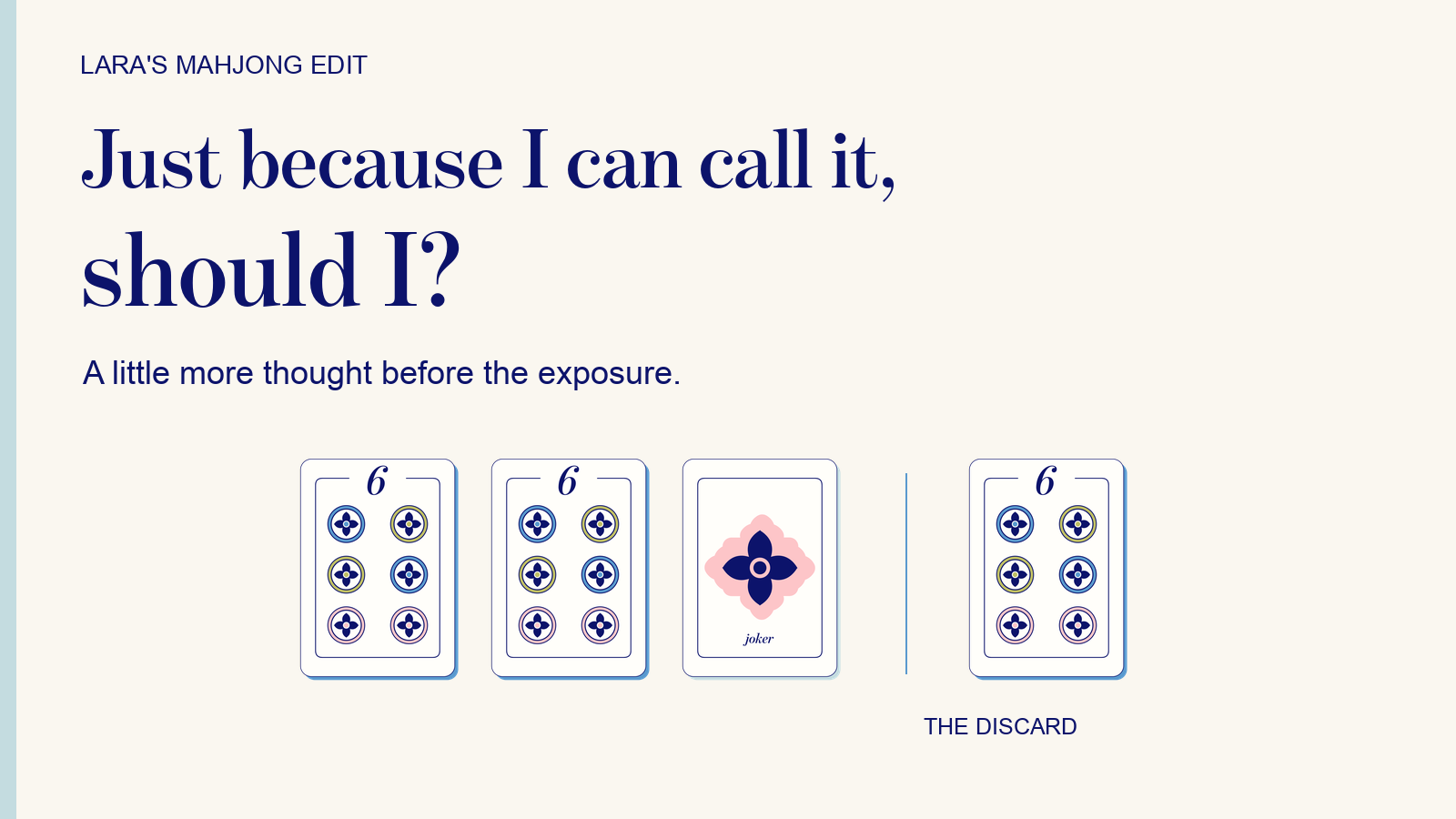
In my October 1 strategy class, I called a tile while we were playing through a hand together. I had a good reason to call. I also had to put a joker into the exposure.
A little later, another player exchanged a matching tile for that joker. I had moved my hand forward, and now someone else had a joker to work with, too.
I like going back to moments like that. There is more to learn from looking at what a decision gave us, and what it cost us, than from deciding afterward that every call was either brilliant or a mistake.
The tile I want is not always the tile I want to call.
What would I have left to finish?
When a tile comes out that matches something in my rack, it is easy to look only at that group. Two of these, one joker, and the tile on the table. There is my kong.
But before I call, I want to look at everything that would still be unfinished.
Do I have the singles and pairs this hand needs? Am I putting my only joker on top of the rack while the rest of the hand still needs several more tiles? Do the suits and group sizes actually match the line I am building?
In that same class, we talked about choosing between two hands. I asked everyone to look at which hand already had its harder pieces in place. Having the singles and pairs secured can make a very different hand from one that has the same number of useful tiles sitting in unfinished pungs and kongs.
That matters when I call, too. Completing one group feels good. I want to know whether the remaining groups give me a workable way to finish.
What am I agreeing to keep?
I can rearrange the tiles inside my rack as I reconsider a hand. An exposure gives me less freedom.
After the exposure is settled, I need a hand that can use that exposed group exactly as it stands. A pung and a kong of the same tile are different requirements. I cannot plan on exposing a pung now and turning it into a kong several turns later.
There may still be other lines available. Sometimes an exposure works with several possibilities. But I want to check those possibilities before I rely on them.
“I'll figure something out” is a familiar thought. I would rather find the line while the tiles are still in my rack.
Is the joker doing enough for me here?
I am willing to expose a joker. Sometimes that is exactly how a good hand moves forward.
I just want to account for it honestly. Once that joker is in an exposure, I cannot freely move it to help a different group. I would need to redeem it legally with a matching tile on my turn. Another player may also be able to redeem it on theirs.
If I am close to mahjong, that can be a trade I am happy to make. If I still need several groups to come together, I may prefer to keep the joker available while I see what develops.
The class game was a useful reminder of that. Someone redeeming my joker did not undo my exposure. It did give another player something useful. Both things were part of the decision.
Could I make the call legally?
The rules come before any of this judgment. For an ordinary exposure, the discard must complete a permitted group of three or more identical tiles in an exposed hand. A single or pair can only be called when the discard completes mahjong. A concealed hand cannot make an ordinary exposure, although it can call its winning tile.
You can find the exposure basics in the NMJL Online explanation. The League's January 2026 bulletin also explains when an exposure becomes fixed.
Once I know the call is legal, I can decide whether I like what it leaves me.
You do not need to get every one of these decisions right to keep improving. At your next game, try looking at the unfinished part of your hand before you reach for a discard. Start considering your likely calls during the other players' turns, so there is less to work through when the tile appears.
In the paid companion, Would You Call It? Three Decisions to Work Through With Me, I have laid out three racks using my House tiles. You can make your choice before reading mine, including one where a very promising-looking hand has a problem worth catching before you call. If you would like to join us for those, you can become a paid subscriber here.
Lara
What makes you hesitate before calling a tile?