

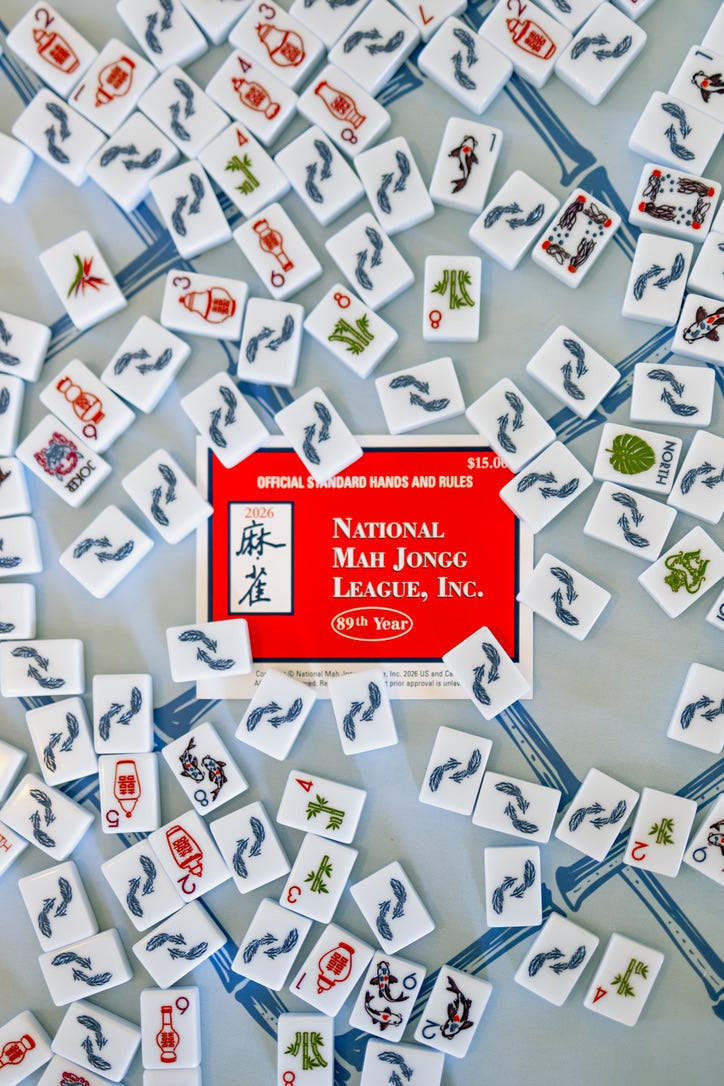
When you are new, looking at your tiles and then looking at the card feels like trying to read two different languages at once. The card has 55 hands on it, and your eyes do not know where to land.
So here is the exact scan I run every game. It is not magic and it is not fast at first. But it is repeatable, and with a little use it really does get down to about thirty seconds.
Step 1: Sort before you scan
Before you even glance at the card, organize your tiles. Group your dots together, your bams together, your craks together, and set your winds, dragons, and flowers to the side. You cannot read a hand you have not sorted. This one step alone removes half the overwhelm, because now you can actually see what you have.
Step 2: Find your concentration
Look at your sorted tiles and ask one question: where am I already strong? Maybe you have three or four tiles in one number. Maybe a little run forming. Maybe a pile of even numbers, or several winds and dragons. You are looking for where your tiles are already clustered, because that cluster is your clue to which part of the card to read.
Step 3: Match the cluster to a section
Now, and only now, go to the card, and go straight to the section your cluster points to. Strong in even numbers? Look at 2468. A run forming? Consecutive Run. Lots of odds? 13579. Winds and dragons? Their section. You are not reading the whole card. You are reading the one or two sections your tiles already nominated. That is the entire trick: let your tiles tell you where to look.
Step 4: Pick two candidates, not one
In those sections, find the two hands you are closest to, not just one. Early on, you want options, because the game will shift. Holding two possible directions keeps you flexible instead of locked into a single hand that might die. Note as you go whether each one is an exposed hand or a concealed one, and remember that singles and pairs cannot use a joker, so those hands lean harder.
Step 5: Let the system pick your discard
Once you have your two candidates, your discard becomes obvious. The tile that helps neither direction is the one that goes. You are no longer guessing what to throw. The scan made the choice for you.
That is the whole system. Sort, find your concentration, match it to a section, pick two candidates, and let that decide your discard. The first few times it will feel slow and deliberate, and that is exactly right. Run it enough and it collapses into a single calm glance, the thing that looks like instinct in experienced players but is really just this, practiced.

For quick daily tips, tile talk, and behind-the-scenes, follow along on Instagram at @larasmahjongedit.
For everything from Lara’s Mahjong Edit, including new lessons, classes, events, and the occasional fun extra, join the Lara’s Mahjong Edit newsletter here.
Lara
That is great advice. But sometimes the tiles dont point anywhere. Even number of odds and evens, one or two winds, dragons or flowers and numbers that dont repeat or no more than two in sequence. What to do then?
How can I subscribe to your newsletter?