

The Charleston is the part of American mahjong that makes new players nervous. You have just been dealt your tiles, you are starting to see a hand take shape, and now you are told to pass three of them away to someone else. It can feel like giving up your good tiles before the game has even started.
It is not that at all. The Charleston is a trade, not a sacrifice. Once you see how it works, you will actually look forward to it.
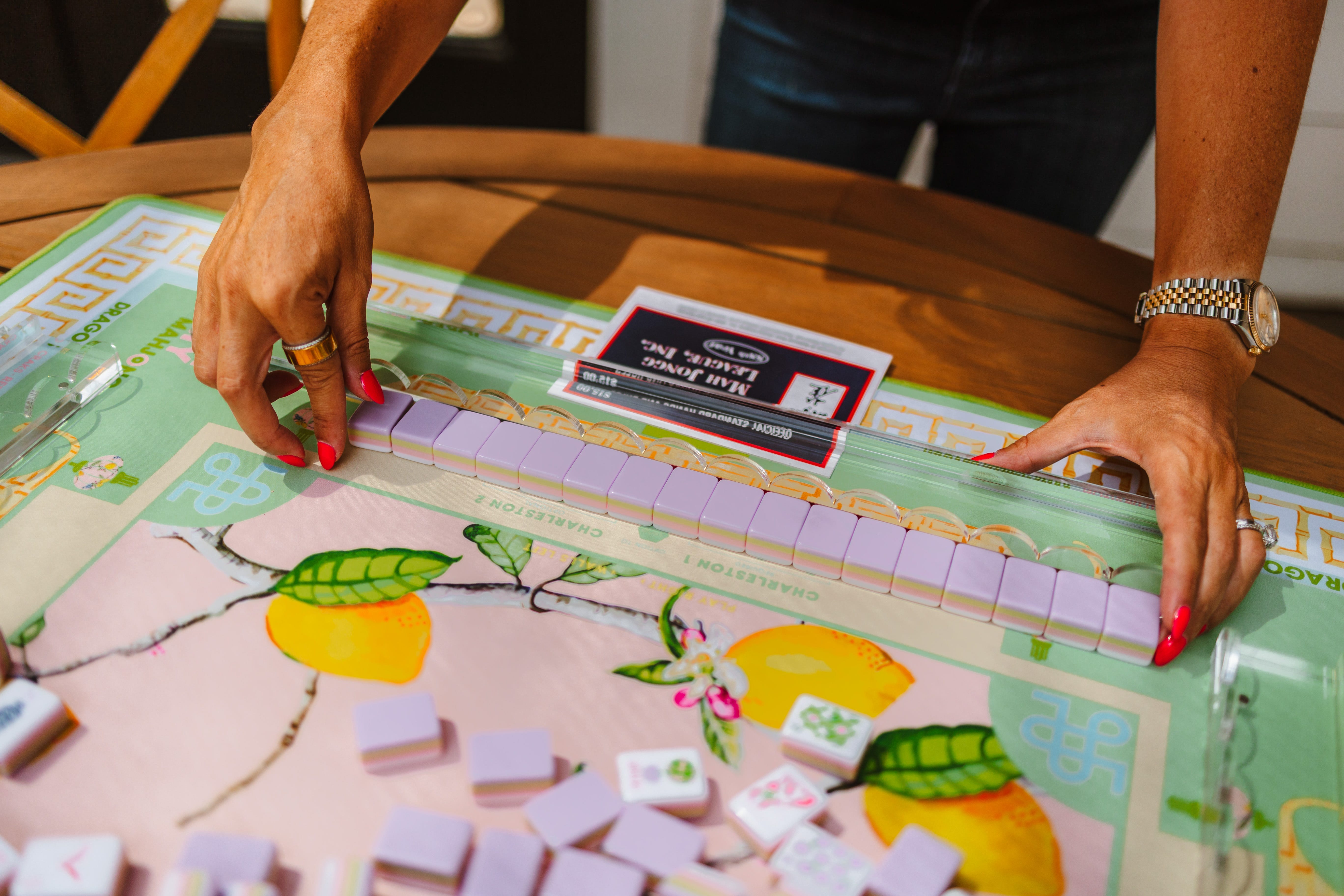
What the Charleston actually is
Before anyone plays a single tile, everyone at the table passes tiles around to improve their hands. You pass three, and you receive three, every single time. So your hand never gets smaller. You are swapping the tiles that do not fit the hand you want for a fresh three that might fit better.
Everyone is doing this at the same time, so the whole table is quietly shaping their hands before the first discard. That is all it is: a few rounds of organized trading to give everyone a better starting point.
The passing order, step by step
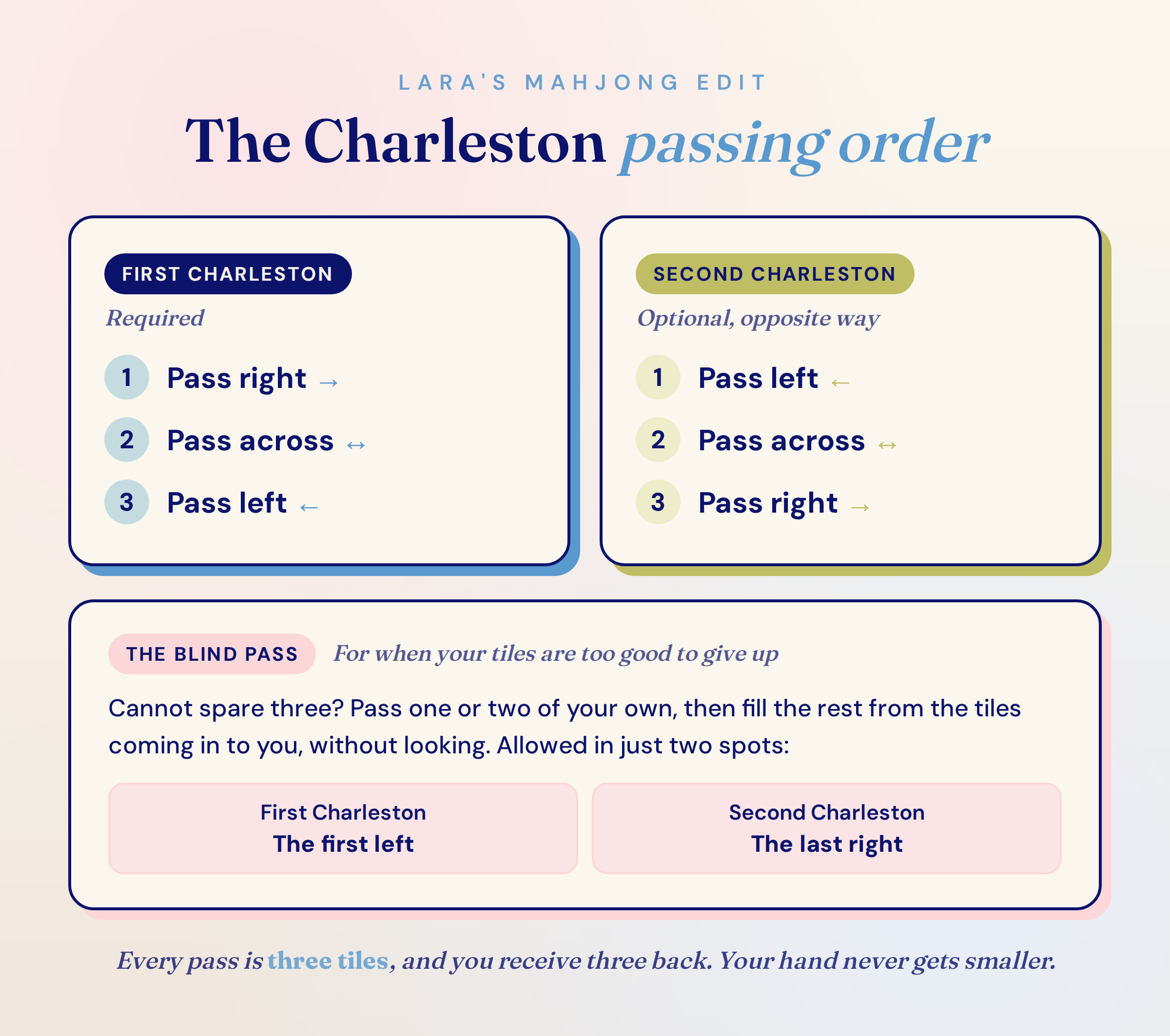
The Charleston follows a set order. The first Charleston is required, and it goes:
Pass 3 tiles to the right.
Pass 3 tiles across.
Pass 3 tiles to the left.*
After that comes an optional second Charleston, which runs in the opposite direction:
Pass 3 tiles to the left.
Pass 3 tiles across.
Pass 3 tiles to the right.*
*These passes also have the option for a blind pass….more on that later.
Any player can stop the Charleston after the first Charleston, so the second one only happens if everyone wants it. All it takes it one person to stop it.
Then there is one last optional move, the courtesy pass, where you and the player across from you can agree to swap up to three tiles - lowest number of tiles wins. After that, East makes the first discard and the game begins.
Why you never pass your best tiles
Here is the reassurance you came for. You choose which three tiles to pass, so you pass the ones that do not fit the hand you are building. The tiles you need stay right on your rack. You are never forced to give away something you want.
Think of it like editing. You are letting go of the tiles that are not earning their spot, and making room for better ones to come to you. If all three tiles you are looking at seem useful, that is a good sign your hand is coming together, and there is a tool for exactly that moment.
The blind pass, for when you cannot spare three
That tool is the blind pass. If you genuinely cannot spare three tiles, you can pass one or two from your rack and fill the rest with the tiles coming in to you, without looking at them. The NMJL allows a blind pass on the first left of the first Charleston and the last right of the second Charleston.
It is how you protect a hand you do not want to break apart. Use it when your tiles are simply too good to give up, not as a habit. Most of the time you will have three tiles you are happy to let go.
The part that finally made it click for me
I used to dread the Charleston. I would stare at my rack convinced I was about to pass away the one tile that would have won me the game. What changed was a simple realization: I get to keep everything I am actually building, and I only ever let go of the tiles I was not using anyway.
Now it is one of my favorite parts of the game. It is the first place a beginner gets to make a real decision, and you cannot truly get it wrong. You pass three, you get three, and your hand gets a little closer to something you can win with.

If the Charleston has been the part that trips you up, you are in good company, and it really does become second nature. Here are two easy ways to stay in the loop.
For these beginner-friendly lessons and strategy notes, subscribe to Lara’s Mahjong Edit right here on Substack. It is free.
For everything from Lara’s Mahjong Edit, including new lessons, classes, events, and the occasional fun extra, join the Lara’s Mahjong Edit newsletter here.
Join the Lara’s Mahjong Edit newsletter here
Lara