

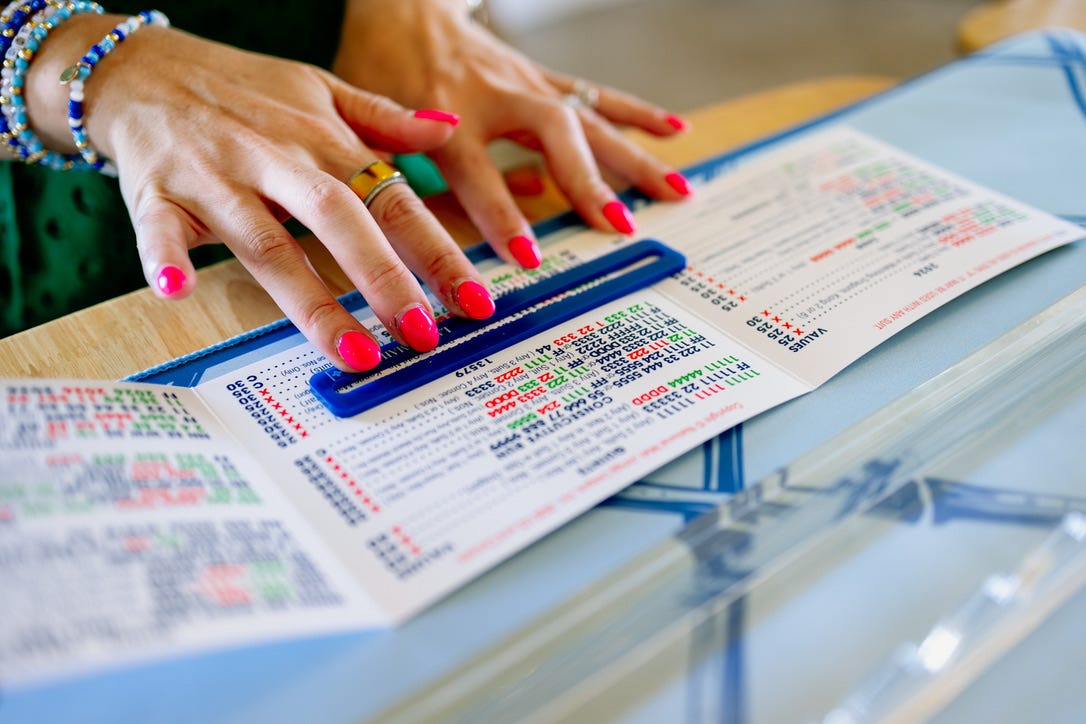
Somewhere along the way, a myth took hold. That the real players have the whole card memorized, and until you do, you are only pretending to know how to play.
I want to put that one to rest. You do not need to memorize the card to play well. Trying to is one of the quietest reasons beginners stay stuck, because it turns a game you are supposed to enjoy into a test you keep failing.
The card is meant to be on the table
Here is the part that gets lost. The card is designed to sit in front of you while you play. Every player has it, face up, the whole game. You are allowed to look at it as often as you like. Nobody is going to slide it away and ask you to recite the 369 section from memory.
So the skill that actually matters is not recalling the card with your eyes closed. It is reading the card with it open. Those are two completely different things, and only one of them wins games.
What to build instead of a memory
Strong players are not faster at remembering. They are faster at scanning. When they pick up their tiles, they are not searching their memory for a hand. They are looking at the card and asking what their tiles could become.
Learn the sections, not the hands. You only need to know roughly where to look. Which part of the card is the consecutive runs, which part is the like numbers, which part holds the singles and pairs.
Read your tiles first, then shop. Notice what you were dealt, then scan the card for the hands those tiles are closest to. Let the card answer the question instead of forcing your tiles toward a hand you already had in mind.
Get comfortable looking. Glancing at the card mid-game is not a beginner tell. It is how the game is meant to be played.
Why memorizing too early backfires
When you push to memorize a few hands fast, you tend to fall in love with those few. You steer toward them no matter what you draw, because they are the ones you know. Your range stays narrow, and you miss the better hand sitting right there on the card because you never looked.
The irony is that the players who lean on the card the most early on are usually the ones who end up needing it the least. Reading it over and over is how the card slowly moves into your head, without a single flashcard.
The one habit worth committing to memory
If you memorize anything, do not make it a hand. Make it a question. Before you commit to a direction, ask yourself, what do my tiles want to be? Then look at the card and let it show you. That single habit will carry you further than knowing ten hands cold.
I taught myself this game with the card propped against a coffee mug, glancing at it every few seconds and feeling sure everyone else had it memorized and I was hopelessly behind. They did not, and I was not. Years later, teaching tens of thousands of women, I still glance at the card every single game. It is not a crutch. It is the tool.
Stop memorizing and start reading the card with a real system. That is exactly what my 2026 Strategy Edit is, a hand-by-hand playbook for this year's card.
If this was helpful, here are three easy ways to keep learning with me:
For one calm, beginner-friendly lesson like this each week, subscribe to Lara’s Mahjong Edit right here on Substack. It is free.
For quick daily tips, tile talk, and behind-the-scenes, follow along on Instagram at @larasmahjongedit.
For everything from Lara’s Mahjong Edit, including new lessons, classes, events, and the occasional fun extra, join the Lara’s Mahjong Edit newsletter here.
Lara